
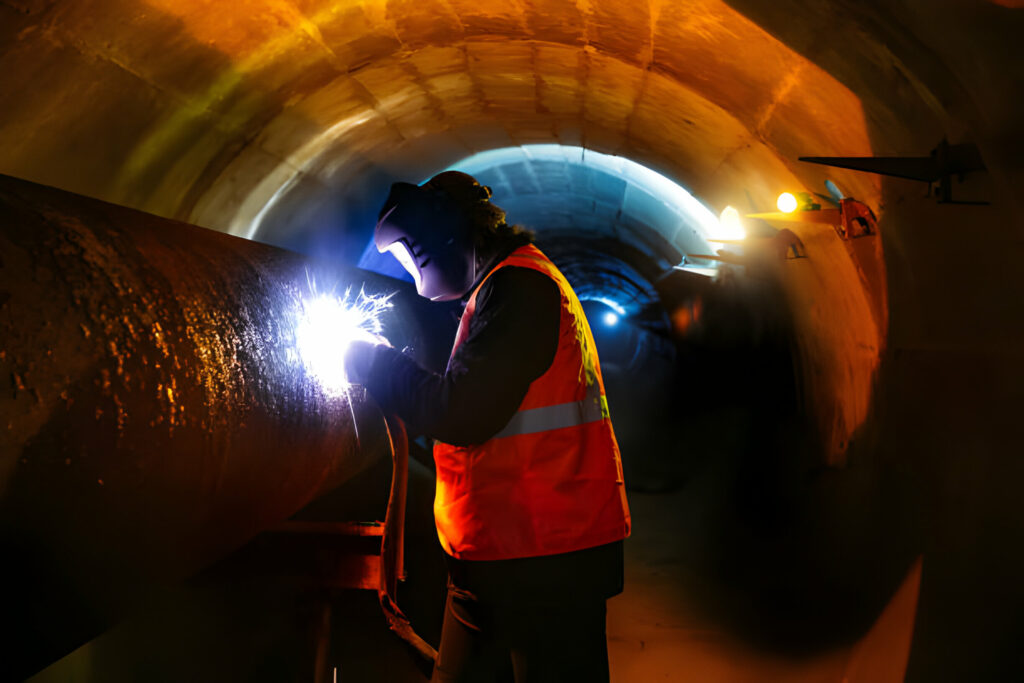
Underwater infrastructure is essential for global commerce, energy, defense, and communication—from subsea pipelines and offshore wind farms to underwater tunnels and telecom cables. Traditionally, building and maintaining these submerged systems required divers to work in some of the planet’s most hostile environments. Today, however, robotics and remotely operated vehicles (ROVs) are transforming how we explore, construct, inspect, and maintain infrastructure beneath the waves.
This article explores how robotic technologies are revolutionizing underwater construction and what the future holds for this rapidly advancing field.
1. The Rise of Robotics in Marine Engineering
The extreme conditions of underwater work—high pressure, low visibility, cold temperatures, and strong currents—make human intervention risky and inefficient. Robotics offers a safer, more effective alternative.
Key Drivers for Adoption:
- Improved safety by reducing diver exposure
- Enhanced precision and repeatability
- Extended operational depth and duration
- Real-time data collection and analysis
From shallow harbors to deep-sea drilling sites, robotic systems are now integral to subsea projects.
2. Understanding ROVs and AUVs
Remotely Operated Vehicles (ROVs)
- Tethered to a surface vessel for power and control
- Equipped with thrusters, robotic arms, HD cameras, and sonar
- Operated by a team on the surface using joysticks and data feeds
- Used for construction, welding, inspections, maintenance, and object retrieval
Autonomous Underwater Vehicles (AUVs)
- Untethered and fully autonomous
- Programmed to perform surveys, inspections, and data collection
- Used in wide-area seabed mapping, pipeline route planning, and environmental monitoring
Together, these vehicles are rapidly replacing manual and diver-based methods.
3. Applications in Underwater Infrastructure Projects
A. Subsea Construction
- ROVs assist in positioning subsea modules, aligning flanges, and operating valves
- Tools like hydraulic cutters and torque tools can be attached for construction tasks
- Real-time feedback ensures precision in low-visibility, high-pressure environments
B. Inspection and Maintenance (IMR)
- ROVs perform routine inspection of:
- Offshore wind turbine foundations
- Oil and gas pipelines
- Subsea cable routes
- Bridge piers and tunnel linings
- Equipped with non-destructive testing (NDT) tools like:
- Ultrasonic testing for wall thickness
- Magnetic flux leakage sensors for steel structures
- Laser scanning for surface profiling
C. Decommissioning
- ROVs cut pipelines, recover equipment, and assist in dismantling obsolete infrastructure
- Minimize environmental impact by allowing precise removal techniques
4. Technology Advancements Driving Performance
A. Sensor Integration
- Multi-beam sonar and LiDAR enable 3D mapping in zero-visibility environments
- Environmental sensors measure turbidity, temperature, salinity, and pressure
B. AI and Machine Learning
- ROVs can identify anomalies like corrosion or cracks autonomously
- Machine vision aids in object recognition, fault detection, and navigation
C. Haptic Feedback and Teleoperation
- Operators now receive force feedback to “feel” what robotic arms are touching
- Improves manipulation tasks like welding, fastening, or material handling
D. Modular Tooling Systems
- Tool skids allow ROVs to switch between equipment mid-mission
- Enhances versatility across different tasks and project stages
5. Benefits Over Traditional Methods
| Traditional Divers | ROVs and Robotics |
|---|---|
| Limited by depth (typically <300 m) | Can operate at >6,000 m depth |
| High-risk due to pressure and currents | Zero direct human exposure |
| Limited working time | 24/7 operation capability |
| Manual data recording | Real-time digital data logging |
These advantages make robotics essential for deep-sea and hazardous environments.
6. Case Studies
Nord Stream Pipeline (Baltic Sea)
ROVs played a key role in:
- Precise pipeline placement
- Ongoing surveillance for leak detection
- Ice scour monitoring
Ørsted Offshore Wind Farms (North Sea)
- ROVs conducted regular inspections of monopile foundations
- Used laser scanners to monitor scour development
- Minimally invasive methods preserved the surrounding marine ecosystem
7. Challenges and Future Directions
Challenges:
- Tether management in complex underwater environments
- Power limitations for long-duration autonomous missions
- Navigation accuracy in deep waters or GPS-denied zones
Future Innovations:
- Hybrid ROV/AUV systems: Combining real-time control with autonomous capabilities
- Wireless subsea charging: Enabling persistent underwater presence
- Swarm robotics: Coordinated fleets of mini-ROVs for large-area inspection
- Human-Robot Collaboration: Augmented reality interfaces for improved control and training
Conclusion
The age of underwater robotics is here—and it’s changing the way we build and maintain our hidden infrastructure. ROVs and AUVs are no longer just tools for exploration; they are critical partners in engineering, construction, and environmental stewardship beneath the surface.
As technology evolves, so too will the scale and ambition of subsea projects. With robotics leading the charge, we are entering an era where the challenges of the deep are not only manageable—they’re being mastered.